Posts

Spring Cleaning Reinvented

Spring Cleaning tips

Spring Cleaning Reinvented

Ah, spring — the season of renewal and rejuvenation. As nature awakens from its winter slumber, so
does our desire to refresh our living spaces. At Lacombe Storage, we understand the importance
of refreshing your living space and it all starts with Strategic Decluttering. After all it’s so much easier to
clean away the cobwebs if there isn’t a lot of stuff in the way. Let’s explore some innovative ways to
make cleaning easier and maximize your living space with the help of self-storage solutions.

Seasonal Rotation:
Maximize your living space by rotating seasonal items in and out of a self-storage unit. Discover the
convenience of storing winter sports gear, holiday decorations, and bulky winter clothing during the
warmer months. Then when things cool down in the fall you can swap these items out and put your
summer sporting gear into the unit. This makes for effortlessly seasonal changes at home.

Creating Functional Spaces: Need a home office, a playroom, or a workout space? Reclaim and live in every square inch of your
home and discover how storing rarely used items, such as off-season recreational equipment or
clothing, can open up new possibilities for organizing and decorating your home.


Home Renovation Solutions:
Are you planning a home renovation project? Self storage offers the ideal solution for safeguarding your
belongings during construction. Explore the peace of mind that comes with knowing your furniture,
electronics, and valuables are secure and protected in self-storage until your renovations are complete.
This April, embrace a clutter-free lifestyle by incorporating self-storage into your long-term organization
strategy. Discover how self-storage units provide a convenient solution for storing seasonal decorations,
sentimental keepsakes, and items with future use potential. With flexible rental options, you can enjoy
peace of mind knowing your belongings are safe and accessible whenever you need them.
Say goodbye to clutter and hello to a more organized and spacious home with Lacombe Storage.


*If you are cleaning to be ready for a move?  Don’t forget we have portable storage units we can deliver to your door.

* Does a move mean changing locations? We have self storage offices in Drayton Valley and Medicine Hat.

Should You Store Jewelry and Other Valuables in Self Storage?

Do not store valuables in self storage

Self-storage is great for household items and non-perishable business stock and equipment, but resist the
temptation to store valuables like jewelry in your unit. Self-storage isn’t a substitute for a vault or safety
deposit box. While self-storage facilities do have security, no security system is completely impervious to
professional thieves. Further your insurance and that of the self-storage operator may not cover valuable
jewelry left in a self-storage unit.

Also consider that jewelry and other collectables often require a special environment to help maintain
their condition. Jewelry, for example, is delicate and needs to be stored where the temperature does not
fluctuate. Temperature fluctuations can cause jewelry to become brittle and warp.

Self storage facilities are also not impervious to things like fires, flooding and tornadoes that can damage
irreplaceable valuables. Safety deposit boxes, however, are designed to withstand these natural disasters.
For these reasons, you are better off keeping jewelry and other collectables in a fire proof safe or safety
deposit box.

Keep valuables in a bank box not a storage unit

At the very least store your jewelry in a secure location that is climate-controlled and can
provide protection against theft, pests, moisture, and other environmental hazards.
Pro Tip for storing jewelry: pack your jewelry in its original boxes or other soft containers to protect
them from scratches so these valuable retain their value for years to come.

If you are interested in other self storage tips and activities, give us a follow on LinkedIn

Pro Tips for Spring Cleaning

Pro Tips for Spring Cleaning

Pro Tips for Spring Cleaning

Spring Cleaning on Your Mind?

But Where to Start?

Experts say spring cleaning has several benefits — a clean home can improve your health and make you
happier. But were to start? Decluttering is the first step, but can be a daunting task. Here are a few
decluttering tricks from the staff at Lacombe Storage to help you get started.
1) Start by decluttering small spaces like a drawer or cabinet and as you gain confidence tackle
bigger spaces.
2) Set yourself up for success by tidying your home slowly in short, manageable spurts. For
example, aim to spend 20 minutes cleaning each day instead of doing it for an entire day or over
a weekend.
3) Honor your natural pace by cleaning as you go about your day. This can look like doing the
dishes immediately after cooking dinner or decluttering your closet while you put away your
laundry.
Do you have a sentimental attachment to items? As such, the thought of decluttering
your possessions may feel overwhelming. Here are some tricks to help you come to terms
with letting go of some belongings:

Spring is in the air

Tips for spring cleaning

1) Try the one in, one out rule. This principle is simple yet surprisingly effective: For every new item
you bring into your home, something you already own must go.
2) Use the inverted decluttering technique coined by author Gretchen Rubin in her book “Outer
Order, Inner Calm.” Instead of focusing on items you want to keep, identify the worst or least
useful things you own. You’ll find clarity and satisfaction in singling out what no longer serves
you.
3) Take a cue from author Emily Ley and ask yourself if an item is the best, favourite or necessary.
This will encourage you to ditch duplicates, hold on to the necessities, and appreciate the
fabulous stuff you already own.
4) Ask yourself if your possessions spark joy. Popularized by Japanese decluttering expert Marie
Kondo this strategy will help you evaluate whether to keep an item or get rid of it based on how
it makes you feel.
5) Use a cut-and-dry trick like the “90/90” rule. Coined by Joshua Fields Millburn and Ryan
Nicodemus of The Minimalists, with this rule you to ask yourself two questions: Have you used it
in the past 90 days? If not, will you use it in the next 90 days? If you answer “no” to both
questions, it’s time to let it go – gift it, donate it, or throw it out.
What tip works to get you started on a decluttering or cleaning spree? Share those tips on our Facebook
Page

Winter Moving Tips

Winter Move

Pro Tips for Moving and storing

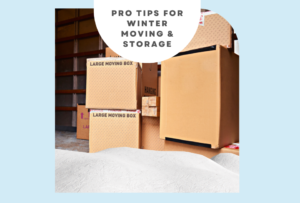
The trailer or back of the truck typically isn’t the warmest place on a cold day and definitely not ideal for your fragile items or electronics. The transition from a warm to a cold environment can cause things to break. If you are going to move or store anything fragile or any electronics, be sure they are well wrapped in something that is going to keep them from breaking and offer some insulation

Here are some other dos and don’t for moving in the cold:

Do Protect Items from the Cold

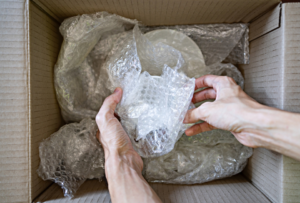
Packing with bubble wrap

Protect your stored items with bubble wrap

Extreme temperatures can make certain items more susceptible to damage. Make sure to use extra wrapping, bubble wrap, thick towels or blankets to protect breakable items and electronics. Remember that containers with liquids can freeze so avoid putting them in the back of the moving truck or into a storage unit. Things like electronics are fine being stored cold as long as you let them cool down and warm up gradually. Consider taking these items with you in the cab of the vehicle to ensure they arrive safely. Check out our YouTube video on packing up breakable dishware.

Do Chose Cardboard Boxes Over Plastic Totes

Everyone loves plastic totes, but there are some drawbacks to using them especially during colder months. Plastic becomes slippery and brittle in the cold making it more susceptible to sliding and falling. And when it hits the ground, it breaks. Cardboard on the other hand has insulating properties for your breakables and its surface doesn’t change during cold weather. This makes it a safer choice for stacking and storing your belongings during the winter.


Do Seal Your Boxes with Packing Tape Instead of Masking Tape

Some adhesives get brittle and lose their stickiness in the cold and this is especially true of masking tape. Packing tape once applied to the box won’t release when it gets cold so you don’t have to worry about the box breaking open.

Don’t Pack at the Last Minute

Leaving packing and cleaning to the last minute can make the moving day more chaotic for everyone involved. The sooner you can get things organized, the easier and faster it will be on the moving day. A good declutter before packing starts will be a big help to know what you really want to pack and unpack. We have a little video on decluttering a closet on our YouTube channel.

Do Make Sure Walkways are Clear of Ice and Snow

Shoveling snow

Clearing sidewalks before a move

We make sure that our yards and the entry way to all storage units is free and clear of ice and snow for your safety. You should do the same at home before you start removing boxes from your home. It hurts to slip and fall, never mind having a box land on top of you.

Don’t Move in the Dark

Night comes early during the Canadian winter and moving in the dark can be unsafe for you and your belongings. Try to work out your schedule so you are moving earlier in the day while it’s still light outside. Please also keep in mind that while our yards are lit at night the insides of storage units are not.

Have a safe move and make sure to bring something warm to drink. If you need to warm up you are welcome to stop by the office. We have someone onsite during the day Monday to Friday.

Should You Store It?

Can you store it?

Should You Store It?

Whether your storage is in a basement, an attic, a garage or a storage unit don’t fill it with things you don’t really want or need. While we’re not going to tackle cleaning out your storage here (a topic for another day), ask yourself these questions before packing things away.

1) Do you need it? This sounds like a simple enough question, but how each of us answers this is highly individual. If you are making an effort to cut back on clutter, try to get real about what “need” means. Defining what is important to you is the first step to efficient storage.

2) Does it work? Don’t let your storage space become the place where broken things go to die! Stop telling yourself, “I’ll fix it one of these days”. If you don’t care enough about the item in question to get it fixed right away, it’s probably not worth keeping.

Broken Watch

Broken Watch

3) Is it clean? Storing clothing and other textile items without having them cleaned first can spell trouble. Moths and other critters are attracted to the dirt on textiles. And body oils will cause fabric to break down over time. Your best defense is to put only clean items into storage. Tools and outdoor equipment, including patio furniture, should also be cleaned before storing to avoid deterioration.

4) Is it yours? It’s amazing how much stuff we can accumulate from others. If you are storing the item in question for a relative or child, consider setting a limit and giving the item back rather than continuing to let it take up valuable storage space.

5) Are you saving it for family? When you save things for family like children or grandchildren, making decisions about what to keep can be a challenge. Often a small amount of carefully chosen and properly stored items can be far more meaningful (and welcome) than an attic’s worth of stuff. Tuck a note about where each piece came from or why it is important to help pass along the stories to the next generation.

6) Will it create a problem if stored? Perishables like food, pet food, plants and potting soils shouldn’t be put into storage as they can create problems by attracting bugs, mice and other pests. Ammunition, chemicals, fertilizers, fireworks and fuels also shouldn’t be stored as they will deteriorate, become unstable and create a fire hazard.

7) Is it irreplaceable? One-of-a-kind items, collectables, jewelry, family photos, and documents like birth certificates and passports should be kept in a safety deposit box or a safe in your home. While storage companies take every precaution to keep things safe and secure break-ins and violent weather can still impact these facilities.

Mona Lisa

Mona Lisa

First Time Storage Tips


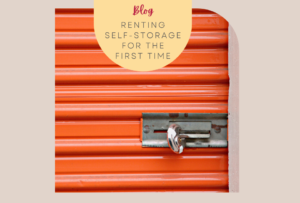
Storage unit and hidden shackle lock

First Time Storage Tips

At some point, you or a family member experience an event where self-storage offers a solution. Whether it’s a move, a renovation, or a death in the family if you’ve never rented a storage unit here are some insider tips to help things go smoothly.

First, determine what size storage unit you need. The quickest way is to inventory what you are storing and use a storage size calculator. This tool can be found on a storage company’s website and can save you the headache of choosing the wrong sized storage unit.

Once you know the size you need check storage prices. Keep in mind that the price given isn’t always the final price. Some storage businesses require a damage or gate fob deposit, or charge admin or service fees.

Now that you have determined the storage facility and a unit size, be prepared for some paperwork. Just like renting a car, or a home, storage rentals require a contract. To keep this as painless as possible have the following information ready:

– Photo ID.

– Your contact information (current address where you receive your mail, your cellphone number and an email address.

– Name an alternate contact for your account (with phone number) in case you can’t be reached for any reason.

– If you are storing a vehicle you will have to show the current registration as proof of ownership.

Before you sign the rental agreement make sure you understand it. You don’t want to find yourself in breach of this legally binding contract, just because you didn’t read it. That’s a little like telling a police officer that pulled you over for speeding that you didn’t see the speed limit sign.

The storage contract will contain things like how much and when rent is due, additional charges, storage rules (what you can and can’t store and acceptable or unacceptable activities in the storage facility), insurance requirements, and the repercussions if you fail to pay rent.

While these contracts can seem daunting a good storage company will have this document written in plain language and have trained staff that should willingly offer to explain it to you.

Pro Tip:

A storage facility’s insurance never covers a renter’s possessions. This is because the insurance company has no way of verifying the value of these possessions. As a homeowner or renter, you may already have content insurance that will cover belongings in storage. Always inquire with your insurance company to ensure items in storage would be covered.

Pro Tip:

When you are talking to storage staff about the contract, also ask if someone is onsite in case you need help while in the facility, what the office hours are and what yard access hours will be.

Once you understand the storage contract, and your questions have all been answered, sign the agreement and then you are ready for the final step, packing your belongings into the storage unit.

Pro Tip:

Before you reach the yard with your belongings, learn how to access the storage facility and your unit. Whether you received a fob, or access code test for facility, make sure it works and check to see if you can get into your storage unit.

Pro Tip:

Your community or the community you are moving to, can be a great source of information as well. Check out local social media sites that will answer questions regarding the involvement of a Storage office in their own local area. For Lacombe we suggest checking out Lacombes community page.

Now you can get down to the business of loading your storage unit. For tips on how to maximize your space check out our blog on how to pack a storage unit.


Storage Tetris – Packing A Storage Unit

Playing Tetris with storage

How to pack to a storage unit

How do you play? you ask. Well, we’re going to try to explain the best we can.

First rule in this game: When you rent a storage unit make sure to get the right size. Too small or too large will mean your belongings don’t fit or you will wind up paying for empty space. A quick tip hear is to use our storage calculator.

Pro tip: Once you have rented the right sized storage unit put a plastic drop sheet on the floor to protect your belongings from moisture that can come up through concrete floors or underneath the roll up door.

Now it’s time to start packing your unit: Placing items like furniture and appliances should be considered first. The best way to play Storage Tetris is to put appliances and large furniture like couches against the far back wall first. Take the backs off loveseats and chairs (if they are designed to do so). This makes it so these furnishings can be stacked.

Once you have those heavier items along the back wall of your storage unit it’s now time to place things like mattresses along the side walls. A little extra advise we found can be checked out in this Museum blog on packing and storing.

Pro tip: put in mattress in mattress bags to protect them from damage during storage.

Place bigger heavier totes or boxes just inside where the mattresses are leaning against the wall. Next stack lighter weighted boxes onto of the larger ones.

Pro tip: to keep everyone accessing the storage unit safely only stack things as high as the shortest person can safely reach.

Lay out of the storage unit

Work toward the center of the unit flowing forward. Remember to put items you will not be needing toward the back and items you will frequently need toward the front of the storage unit. As in the game of Tetris, fill gaps with similar shaped items to create tight stacks that maximize the space. Shelving units can be used to store boxes.  This also helps free up the floor space for more awkward shaped items. The “Tetris” effect is a great read from a company called You Move Me.

Pro tip: make sure to leave yourself a center isle.

Pro tip: Try not to place cardboard boxes near the front of the unit as rain and/or snow can leak in.  Once you’ve got the unit loaded cover as much as you can with a dust cover to keep it clean and ready to use.

Now you are ready to pack and store your belongings successfully. Remember heavy items at the back along with items you won’t need any time soon and lighter or frequently needed items at the front. If you something you need that we don’t carry, please check out our friends over at Nowco Home Hardware.

Once you are ready to go, head over to our rental page and secure your spot!

Protecting Items In Storage

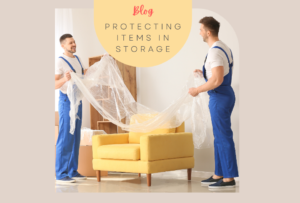
Using a Drop Cover for Protection

Protecting Items with Dust Cover

You’ve made the decision to place your items in storage and now that you have everything
ready go, here are some simple tips to protect what you are storing:

Confounded Condensation
Depending on the weather extremes and humidity in your area, it is possible for condensation
to build up on your stored goods which can cause water and mold damage. A good option to
avoid damage from prolonged moisture exposure is to put a plastic drop sheet on the floor of
your storage unit before placing items in the unit. Using pallets to put your belongings on is
even better, especially if you are storing goods for longer periods of time. Also, leave some
‘breathing space’ (about two finger widths) between stacked items so fresh air circulates
between your belongings.

moving furniture

Man with moving boxes

Don’t Over Stack
When placing boxed items in storage, the temptation is to stack as high as you can reach. Boxes
are only designed to take so much weight and over time might give way under the stress of
over stacking. This can result in entire stacks toppling over. If the items in those boxes are
fragile… well, you get the point. You also need to consider your safety. For this reason, stacks
should only go as high as your natural reach…or the natural reach of the shortest adult
accessing the storage.

Dreaded Dust
Nobody wants to open their unit and find that everything inside is now dust covered. All that
cleaning you did to prepare your goods for storage has been potentially wasted – and let’s face
it: dust is inevitable. So why not use a couple of inexpensive plastic drop sheets to help protect
your items? Drop sheets should be draped loosely around items to encourage air flow but offer
protection from fine dust.

By using these three tips, your stored goods should remain intact, dry and dust free. Be sure to
check out the retail items available for purchase
at our locations to assist with your packing needs. We are here to help you through every step
of your rental process.
You can access more information on our blog site such as the importance of cleaning before you store, as well as make use of our handy
storage calculator to determine the correct unit size for your needs.

Extra Help

This YouTube video has a lot of good information on storage for you as well.

Ron Heizelman – Site Manager, MHS

Preparing Belongings For Storage

Before you pack your belongings into storage, you need to get them ready. From cleaning to taking inventory, here’s how to best prepare.

Purge

If you haven’t used something in a while or no longer want an item don’t waste money storing it. Sell it or donate it to someone who will make better use of the item.

Clean everything that’s going into storage

Before you put things into storage make sure they are clean. Why is this important? If you store something while it’s dirty, it’s only going to be worse for wear when you unpack it two, four, or twelve months later. Over time things that are stored dirty can acquire a musty smell, and stains can damage fabrics. A thorough cleaning will ensure that items don’t deteriorate while in storage.

Pro tips:

  • Wash clothes and linens then store them in plastic bags to prevent mold and mildew.
  • Vacuum out the crevasses and wipe all furnishings then use an appropriate protective spray on leather and fabric upholstery. Wax wood furniture.
  • Wipe the inside and outside of appliances. If applicable, run a final wash cycle with vinegar. If you are storing a washer, make sure all tanks and hoses are drained. For fridges and freezers add a moisture absorbent substance like charcoal to help prevent odors. Check your local appliance stores for any other help or suggestions. 
  • Wipe all sporting goods and kids’ toys including plush toys. Store plush toys in plastic bags.


Inventory what you’re storing

While you are cleaning your belongings, write down what’s going to be stored. Why is this important? An inventory will help you determine what size storage unit you need and how to organize that storage unit.

Pro tips:

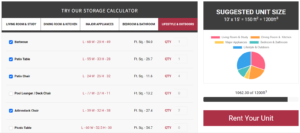
  • Our storage calculator web page allows you to enter an inventory of your belongings and calculates what size storage unit you need. You can also email this list to yourself right from our storage calculator page.
  • Add a brief description including the item’s brand, serial number, model number, and if there is any damage to your inventory list.
  • Email a copy of your inventory list to your property insurance agent and advise them that you are putting these items into storage. This will help ensure that you have coverage for these possession’s and speed up the claims process should disaster make this necessary.


Make sure you get the right size of storage unit

Our easy-to-use storage calculator does the math for you. Once you’ve entered an inventory of your possessions into the calculator the graph on the right side of this web page tells you what size storage unit you need. You can then go ahead and book your storage unit either by clicking on the Rent Now button on our website, or if you need help you can call us and talk to someone in our office.

Pro tip:

  • Right now, we are experiencing high demand for storage units and have a waiting list for many sizes. Renting online allows you to quickly see and rent any size that is available. This is kind of like a gamer’s cheat code for self-storage. If the size you want isn’t available don’t give up. People come and go from self-storage units daily. So, call our office and get on the waitlist right away.
  • Self Storage Calculator

Now you will need to pack your belongings. How you pack an item determines how well it survives a move, storage and then being unpacked.

Head over to our YouTube channel to see us packing up Sues china into the properly made boxes and inserts.

Watch for our next blog — How to pack your belongings like a pro so they are in good condition when you take them out of storage.

Earth Day

It's Earth Day at Lacombe Storage

It’s Earth Day at Lacombe Storage

Earth day is coming April 22 and amid all the chaos of the past few years we wanted to put the focus back on the future of our families and our community here at Lacombe Storage. After all, the way we treat the environment now will affect future generations. 


A planet that is growing warmer each year isn’t good for any living thing. We can’t become complacent to this threat to the world, so Lacombe Storage has focused on offering only moving boxes made from recycled material and going paperless in our office. Below are just a few positive effects this action has on our community and the world.


Protects trees (our shield against CO2)

Trees are considered carbon sinks. Trees lock away carbon dioxide in the wood, roots, and leaves. “This locking-up process ‘stores’ carbon as wood and not as an available ‘greenhouse’ gas. Trees are imperative to earths survival so it is beneficial to protect them as best we can.” Steve Nix forestry expert on 


Reduces paper waste

According to  , in 2022, paper mills will produce about 500 million tons of paper and cardboard. Paper waste produces pollution which is toxic to air, water, and soil. Paper is produced by using chlorine-based bleaches so when paper rots in the landfill Methane gas gets released. This gas is worse than CO2. Using products made with recycled products and going paperless significantly reduces paper waste and in turn reduces the amount of toxic gasses entering our atmosphere.


Saves water

The amount of water used to produce one piece of paper is 10 litres. The less paper we use in our office, the less of the life-giving resource is wasted.


How is your family or business being environmentally conscious? We’d love to hear your ideas so that we all can do a little better to help our home — planet Earth.